


.

Industrial networks tend to become complicated gradually. A project may start with a few controllers and Ethernet devices, but cameras, wireless access points, HMIs, monitoring equipment, and other connected systems are often added later. At some point, the network is no longer just about connecting devices. Traffic needs to be organized, different systems may need to be separated, and the network equipment itself has to work reliably in a demanding environment.
This is one of the situations where an L2+ Managed Industrial Switch becomes useful. It gives network engineers more control over the way an industrial Ethernet network is built and managed, while also providing the physical durability expected from industrial networking equipment.
When Basic Connectivity Is No Longer Enough
An unmanaged switch can work well when the network is small and straightforward. If several devices simply need to communicate with each other, there may be little reason to introduce additional management functions.
Industrial networks are rarely that simple for long.
A production line might have PLCs and control equipment communicating alongside IP cameras and wireless devices. A factory may have several network segments that need to be kept separate. A remote installation may also need fiber connections because copper cabling is not practical over the required distance. When these requirements start appearing together, the switch becomes an important part of the network design rather than just a box with Ethernet ports. A Managed Industrial Switch gives administrators more options for organizing the network and controlling how different devices communicate. This becomes increasingly valuable as the number of connected devices grows.
Keeping Different Industrial Systems Organized
One of the common problems in a growing industrial network is that too many devices end up sharing the same network environment. Surveillance traffic is a good example. IP cameras can continuously generate large amounts of data, while control equipment may have very different communication requirements. Wireless devices can add another layer of traffic.
Keeping everything in one flat network may work at first, but it becomes harder to manage as the system expands.
An L2+ Industrial Switch can help create a more structured network through functions such as VLAN-based segmentation. Different groups of devices can be logically separated while still using the same physical switching infrastructure.
This approach is useful when a project has separate requirements for surveillance, control, wireless access, or other industrial services. It also makes the network easier to understand when engineers need to troubleshoot a problem later.
Dealing With Increasing Network Traffic
Network traffic is another issue that is easy to underestimate during the early stages of a project.
Consider a surveillance installation with multiple Gigabit IP cameras. The network is not only carrying video from the cameras. Monitoring systems, storage devices, access points, and other Ethernet equipment may be communicating at the same time.
If the switching infrastructure cannot handle the traffic efficiently, users may eventually notice delayed video, unstable connections, or other performance problems.
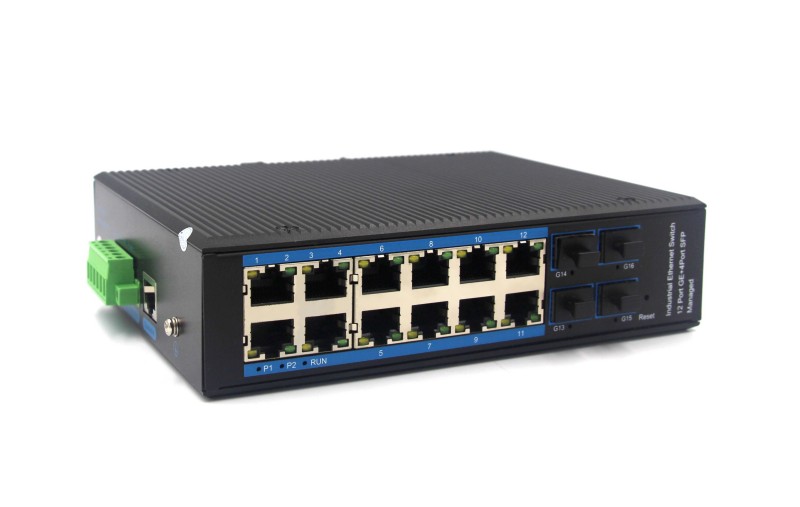
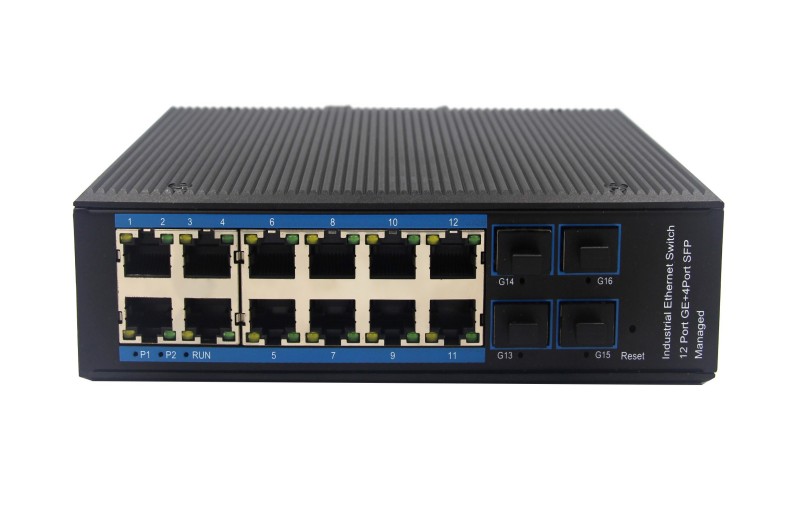
The Yuhang ZX412BGS-SFP is designed for this type of demanding Ethernet environment. It is a hardened 16-port Industrial Ethernet Switch with non-blocking wire-speed performance, providing 12 × 10/100/1000BASE-TX RJ45 ports and 4 × Gigabit SFP ports.
The combination is useful for networks that need both copper device connections and fiber uplinks. More importantly, the switch is designed so that its switching capacity does not unnecessarily become a bottleneck as network traffic increases.

When Fiber Makes More Sense Than Copper
Copper Ethernet remains common in industrial installations, but it is not always the best option for every connection.
Some devices may be located in different buildings or at the far end of a facility. In other cases, the industrial environment may contain electrical equipment that makes fiber an attractive choice for certain network links.
The four SFP ports on the ZX412BGS-SFP allow fiber connections to be incorporated into the network without requiring a separate fiber-only switching platform.
This gives network designers more flexibility when planning uplinks or connecting different areas of an industrial site. It is a relatively simple feature, but it can make a significant difference when the physical layout of the network is more complicated than a single control cabinet.
Power Failure Is Also a Network Problem
Network performance is only useful if the equipment remains powered. In an industrial environment, a switch may support surveillance cameras, control systems, wireless equipment, or other services that are expected to remain available during normal operation. If the switch loses power, all of those connected systems can be affected at the same time.
The ZX412BGS-SFP uses a redundant power system, providing an additional layer of protection against a single power supply failure.
Redundant power does not make a network immune to outages, but it removes one common point of failure from the switching equipment. For applications where network availability matters, that can be an important consideration during equipment selection.
Industrial Networking Equipment Has to Survive the Environment
A network switch installed inside an office has a relatively easy job.
It normally operates within a controlled temperature range, stays away from machinery, and is rarely exposed to significant environmental changes. Industrial networking equipment can face very different conditions.
Outdoor cabinets, factory floors, equipment rooms, and remote installations may experience high or low temperatures for extended periods. In these situations, environmental specifications become part of the network design.
The Yuhang ZX412BGS-SFP supports an operating temperature range from -40°C to 80°C, making it suitable for applications where temperature conditions are outside the range normally expected in commercial IT environments.
The switch also uses an IP40 rugged enclosure. Combined with its strong construction and slim form factor, this makes it easier to integrate into industrial installations where space and environmental conditions both need to be considered.
Surveillance Networks Need More Than Just Ports
IP surveillance is one of the clearest examples of why industrial switching equipment needs to be selected carefully. A camera may appear to be a simple Ethernet device, but a large surveillance system can generate continuous network traffic. When cameras are distributed across a factory, warehouse, transportation facility, or outdoor area, the network may also need to cover considerable physical distances.
This is where the combination of Gigabit RJ45 ports and SFP connectivity becomes practical.
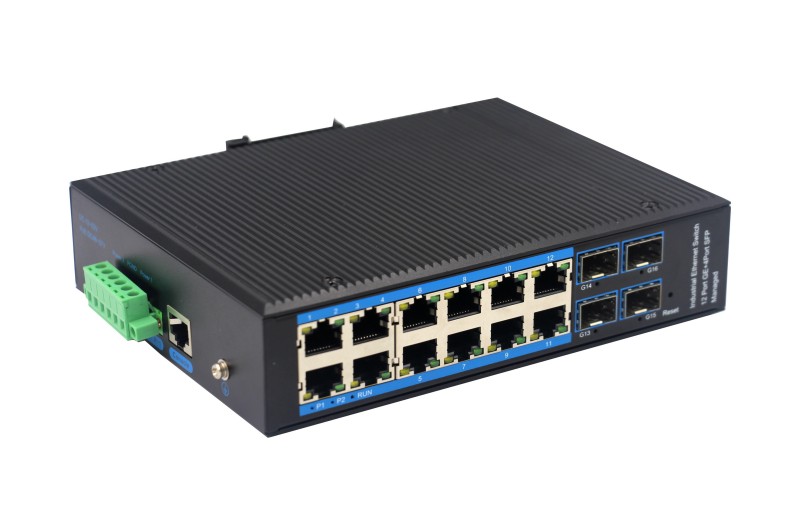
The ZX412BGS-SFP can connect local Ethernet devices through its 12 Gigabit RJ45 ports while using its four SFP ports for fiber-based network links where required. For surveillance system deployments, this provides a flexible switching platform without requiring separate equipment for copper and fiber connectivity.
Control Networks Have Different Priorities
Surveillance is only one application.
Industrial control systems may include PLCs, HMIs, controllers, sensors, and other Ethernet-based devices. The network supporting these systems needs to be properly structured because communication problems can affect more than just data transfer.
This is another reason companies may move from an unmanaged device to a Managed Industrial Switch as their network grows.
Management functions give engineers greater control over network segmentation and traffic organization. Instead of treating every connected device in exactly the same way, the network can be designed around the requirements of different systems.
For a small installation, this may not be necessary. For a larger control network, it can make day-to-day management much more practical.
The Advantage of a Slim Industrial Switch
Physical installation is sometimes overlooked when comparing industrial networking products.
A control cabinet may already contain PLCs, power supplies, terminal blocks, controllers, and other equipment. There may not be much room left for a large networking device.
The slim housing of the ZX412BGS-SFP is therefore more than a cosmetic feature. It gives installers more flexibility when working inside cabinets or other space-constrained locations.
This matters particularly in retrofit projects, where the network equipment has to fit into an existing installation rather than a newly designed cabinet.
Choosing an L2+ Managed Industrial Switch
Not every industrial network requires an L2+ managed switch. For a small installation where devices simply need to communicate, an unmanaged industrial switch may be sufficient. But when the network involves multiple applications, higher traffic levels, network segmentation, fiber uplinks, or more demanding management requirements, a Managed Industrial Switch can provide much greater control.
The selection process should therefore begin with the network itself.
How many devices need to be connected? How much traffic will they generate? Are fiber links required? Will the switch be installed indoors or outdoors? What temperature range does the site experience? Is redundant power important? Does the network need segmentation or other management functions? These questions are usually more useful than simply comparing the number of ports between different models.
Yuhang ZX412BGS-SFP for Demanding Industrial Ethernet Applications
Yuhang develops industrial networking equipment for applications where reliable connectivity has to work alongside demanding environmental conditions.
The ZX412BGS-SFP combines the features needed for a range of industrial Ethernet deployments in one compact platform. It provides 12 Gigabit RJ45 ports and four Gigabit SFP ports, together with non-blocking wire-speed performance and a redundant power system.
Its operating temperature range of -40°C to 80°C and rugged IP40 housing make it suitable for climatically demanding environments. The slim enclosure also helps simplify installation where cabinet space is limited.
The switch can be used for applications including surveillance systems, control management, and wireless service, particularly where standard commercial networking equipment may not be designed for the surrounding conditions.
The Real Value Is in Solving the Network's Weak Points
An industrial switch should not be selected simply because it has more ports or more management features.
The better approach is to look at where the network is most likely to encounter problems. Maybe different systems need to be separated. Maybe surveillance traffic is putting pressure on the network. Maybe the site requires fiber connections. Maybe the switch will be installed somewhere with extreme temperatures, or a single power supply is considered too much of a risk.
An L2+ Managed Industrial Switch can address many of these requirements by giving engineers greater control over the network while providing hardware designed for industrial conditions.
For applications that require a combination of Gigabit copper connectivity, SFP fiber interfaces, redundant power, rugged construction, and a wide operating temperature range, the Yuhang ZX412BGS-SFP provides a practical option for building a more resilient industrial Ethernet network.